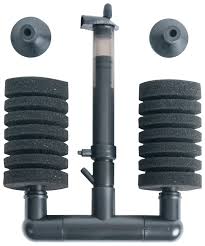
Penn-Plax Air-Driven Sponge Filter
Disclosure: This page contains affiliate links. If you buy through them, we may earn a commission at no extra cost to you. As an Amazon Associate we earn from qualifying purchases.
Appears in these guides
Review
Who this is for: The Penn-Plax Air-Driven Sponge Filter is aimed at hobbyists who keep small to medium freshwater tanks and want a low-flow, low-maintenance filter. It is often chosen by people keeping fry, shrimp, bettas, or lightly stocked community tanks where gentle filtration is preferred.
Key features: The unit relies on sponge media and an air lift tube to provide mechanical and biological filtration without an electrical pump in the filter body. The sponge provides surface area for beneficial bacteria while also trapping debris, and the design is compact so it can fit into tight setups.
Performance: In many setups the filter delivers steady, gentle circulation and reliable biological filtration when paired with an appropriate air pump. Performance will vary with tank size, stocking level, and the capacity of the air pump you use, so it is best treated as a modest-capacity filter rather than a high-output option.
Usability: Assembly and installation tend to be straightforward: place the sponge in the tank, connect tubing to an air pump, and position the lift tube. Operation is typically quiet and the unit runs continuously as long as the air pump is working. Some users appreciate that the airflow is easy to adjust by changing pump output or adding a valve.
Maintenance: Maintenance mainly consists of periodic sponge rinses in aquarium water to avoid killing beneficial bacteria. Cleaning frequency depends on bioload and debris build-up and is often every few weeks to a couple of months. When the sponge becomes permanently compacted or damaged, replacement is the usual solution.
What to watch out for: This type of filter may not keep up in heavily stocked or large tanks and will need a suitable air pump to maintain flow. The sponge can trap a lot of debris and may need frequent rinsing in dirty tanks. Also consider that it provides limited mechanical polishing compared with larger filter types, so additional filtration or more frequent water changes might be necessary in high-demand systems.
- Match sponge size to tank volume and stocking level.
- Use a reliable air pump with adjustable output where possible.
- Rinse sponge in old tank water to preserve bacteria colonies.
- Monitor flow rate; replace or clean the sponge when flow drops noticeably.
- Consider as primary filter for small tanks or as supplemental biological filtration in larger setups.
This draft review was generated by AI and should be verified against the manufacturer's specifications and user reviews.
Pros
- Gentle flow suitable for fry, shrimp, and delicate fish
- Sponge offers ample surface area for beneficial bacteria colonization
- Simple assembly and straightforward cleaning routine
- Runs on a basic air pump, so electrical parts in the tank are minimal
Cons
- Not intended for heavily stocked or large aquaria
- Requires a separate air pump and tubing
- Can clog with debris and lose efficiency if not cleaned
- Limited mechanical polishing compared with larger filter types